Check it out! Big Interview is a free online tool that combines training and practice to help improve your interview technique and build your confidence. Big Interview can also help you with resume writing, how to negotiate, and how to navigate the first 90 days of a new job. Simply log in using your WVU login credentials.
Congratulations on receiving an interview!
Preparation and practice are your keys to success. You can learn about what the employer might do in the interview, but you can’t control it. What you can control is how well prepared you are for every interview.
Know the Job
- Study the employer’s job description and understand the tasks you’ll be asked to perform, the desired outcomes and where they fit into the bigger picture of what the employer is trying to do.
- Understand the skills, traits, knowledge base and experiences possessed by their ideal candidate.
- Within the organization, look at jobs at higher levels so you can speak to career paths and your goals.
- Research the employer and talk to your network about the work environment, culture and values.
Know Yourself
- Be prepared to discuss how your skills, traits, knowledge areas and experiences align with the job.
- Envision yourself making a good impression, answering the employer’s questions, asking your questions and then closing the interview.
Practice, Practice, Practice
- Practice interviewing, so you’ll know when you’re hitting your mark and can identify areas of improvement.
- Gain experience with different styles and types of questions.
- Interview Questions
What to Bring and How to Dress
- Prepare questions in advance. Write out questions and let the employer literally see how prepared you are.
- Bring material to take notes, this will be helpful when reflecting on the experience following the interview.
- Dress for success and the company culture.
Your next interview may not be face-to-face—it could be through Zoom, Skype, HireVue, or another virtual platform.
According to one recent survey, 55 percent of employers have used video interviewing as a college recruiting tool and more and more employers are recognizing video as a useful interviewing tool.
Getting ready for your video interview isn’t hard, but there are specific steps you can take to ensure you interview at your very best.
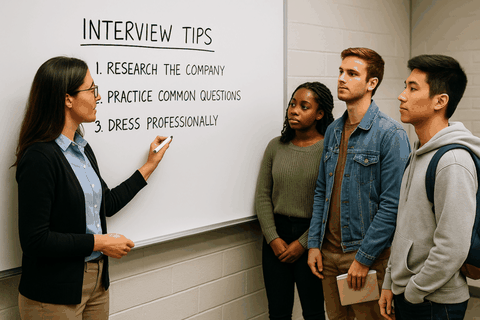
The good news is: Everything you do for an in-person interview is needed for your video interview. Research the company. Practice answering potential questions. Have a list of questions you would like to ask. Dress professionally for the interview. Write a thank-you note after the interview.
Here’s how to turn a regular interview into your video interview:
Check first with your university’s career center. It may be set up for video interviews. Plus, staff there can help you practice—and practice is key to a successful interview. If you are doing the video interview on your own, be sure to practice.
If you are handling the video interview on your own, choose the device you’re most comfortable using. You can use your computer, a tablet, or your smart phone. Test your equipment well in advance of the interview. On the day of the interview, make sure the battery is at full power and the camera lens is clean.
Check your Internet connection. If you share a connection, you may want to ask others to stay off the Internet while you are interviewing. Be sure to check your connection an hour before the interview to ensure everything is working. And, have a backup plan in case something goes wrong.
Choose a good location. You want a quiet place—no roommates, no pets, no distracting noises. You want a plain background (in front of a solid color wall is perfect) and you want your desk or table to be free of clutter. (You can have your notes, your resume, and paper to take notes.) You want the room to be well-lit so that the interviewer can see you clearly. Use diffused lighting—nothing harsh or direct so that you won’t have shadows or glare.
Position your camera so that it is level with your head or angled just slightly downward (you don’t want the camera looking up your nose). The camera should be far enough away that it captures you from the waist up.
Now that you’re ready, do a test interview. Ask a friend to help you practice your interview using the technology you’ve just set up. Fix any problems (sound, lighting, camera placement) now. If you can, record the interview so that you can review it and improve your performance.
On the day of the interview, dress in your complete interview outfit. Do not just dress from the waist up: You may need to stand up during the interview, and don’t want to be wearing pajama bottoms. In addition, make sure your clothing doesn’t blend in with your background.
Turn off all your apps prior to your interview. You don’t want distracting noises during the interview.
When the connection between you and the interviewer opens, look directly at the camera, not the screen, so that you’re making good eye contact. Use positive body language. Smile and nod when appropriate. Keep your hands off your face. Speak in a conversational tone.
Pause briefly—about three seconds—after each question before you respond so that you don’t talk over the interviewer. Nod at the interviewer to show you’ve heard the question.
Use your notes if you need them, but remember that this is a conversation between you and the interviewer. Avoid looking down at your notes as much as possible.
Once the interview is finished, thank the recruiter for the interview. Then, be sure the connection is closed before you do anything else.
Finally, don’t forget to e-mail your thank-you note to the person who conducted the interview.
Courtesy of the National Association of Colleges and Employers.
The interview process begins the moment you interact with the organization—whether you’re entering the building, starting a virtual meeting, or making a phone call. It’s essential to make a strong and lasting impression on everyone you meet, including the interviewer, the receptionist, and any other staff members. Remember, their opinions may play a crucial role in the final decision-making process. Strive to showcase your professionalism, approachability, and enthusiasm at every step; it can set you apart as a standout candidate.
Additionally, interviews may be focused on gathering additional information surrounding your resume, experience, behavior and/or a combination of hypothetical client case experiences.
Sending a follow-up message after an interview to express your gratitude and appreciation can help you stand out from other candidates. Follow-up messages allow you to thank the interviewer for their time, remind them of the position you applied for, highlight examples of your skills that align with the position, and reiterate your interest and enthusiasm for the role.
Follow-Up Messages Best Practices
- Send the thank you via email or note by mail within 24 hours after your interview.
- Address the message to specific individual(s).
- Keep the message brief, while expressing appreciation, highlighting the position and your skills.
Alert Your References
From applying to a position and throughout the interview process, ensure to let your references know to expect a call or email from any organizations you are speaking with. Throughout the process, keep your references up to date with timely messages, highlighting the position description, employer profile and employer contact information.
For additional information and suggested questions to help identify work culture, position responsibilities, practice interviewing and more, schedule an appointment with your Career Development Specialist through your Handshake account or contact us at careercenter@mail.wvu.edu.
Congratulations, you’ve just been offered your first professional job in the real world. You breathe a sigh of relief: The search is over. Unfortunately, it’s not. In many ways, the real work, deciding whether this job is really the one for you, is just about to begin.
Looking for a job after college is difficult enough. Deciding on a job offer when it comes is often even more challenging. After all, you’re not only talking about one, two, three years or longer of your life. You’re talking about the launch of your career. A sound decision will make that launch a successful one. But a poor decision could mean entry-level career disappointment.
Check out our Research Salaries and Negotiate Offers page!
Table manners play an important role in making a positive first impression. They are a visible reflection of your professionalism, confidence, and respect for others which are qualities that can influence relationships with employers, clients, and colleagues. Whether you’re attending a networking lunch, interviewing over a meal, or dining with business associates, your etiquette can speak volumes.
Visit our Dining Etiquette page to learn how proper business dining etiquette can help you make a positive first impression, build professional relationships, and confidently navigate business meals.
Business formal attire is conservative not creative
This page is meant to help you prepare for formal, professional settings like interviews, networking events, or industries where business professional attire is the standard.
Business formal attire should be worn during a formal interview for a job or professional school. While business formal is almost exclusively “suit and tie”, there are different ways to make the more conservative look your own.
What is most important to remember is to represent your true self—your culture, your personality, your comfort—but in a polished way. This shows respect to the organization and the people you are meeting, and shows your care for yourself.
Suits or tailored outfits such as a jacket and dress, pants, or skirt
A suit or tailored dress is the most professional attire. Choosing a conservative, classic style is usually a good rule because it is versatile (appropriate in an interview and in many professional settings) and a good investment. Choose a fabric that can carry you through several seasons, such as lightweight wool crepe or wool gabardine.
Of course, your chosen career path will influence what you wear. Many career fields, such as law, finance, or accounting, tend to be conservative, a fact reflected in the way people in these fields dress. Other fields, such as fashion design or art, allow greater creative expression. Some professions, such as sales, marketing, and education, bridge the gap between the creative and the traditional fields. In these fields you can update and add some flair to a classic, traditional style.
Color and Pattern
Build your professional wardrobe around a neutral color like navy, charcoal gray, black, off-white, camel (beige, khaki, or taupe), or olive. The best patterns for professional suits are solid, houndstooth, tweed, and plaid.
Shirts should be traditional cotton or cotton-blend shirts with long sleeves and straight or button collars, they should be well-pressed and the collar should be loose enough to fit one finger between the neck and collar.
Avoid overly sheer, flashy, or embellished materials. Choose tops that are polished and appropriate for a formal setting.
Shoes and Hose
Styles should be on the conservative side. Neatness is important, so make sure that your shoes are clean and polished. Comfort is essential, Do not buy shoes that hurt. Shoes should be as dark
Your shoes should match the color of your belt for a coordinated look.
Hose should be neutral or match your shoes.
Accessories
Accessories such as handbags, belts, and scarves should be coordinated with your outfit.
When choosing a handbag, pick one versatile enough to coordinate with many outfits. Go with the most prominent neutral color in your wardrobe.
Jewelry
Stay away from dangling earrings, multiple rings, and noisy bracelets. Jewelry that moves too much or makes noise is distracting. In choosing jewelry, choose gold, silver, or pearls. Simple stud or small hoop earrings are classic choices that work well in most formal settings. Pendants or brooches can add sparkle to a blazer lapel or collarless jacket.
Personal Grooming
Select a hairstyle appropriate for your hair type, face, life-style, profession, and personality. Your hair should be clean, neat, and controlled. Long hair should be pulled away from the face for the most professional look. The condition of your hair is also important. Take care of your hair. Dry, brittle, or bleached-out hair communicates poor personal hygiene.
Facial hair should be clean and neatly groomed to maintain a professional appearance.
Nails should be short and well groomed. Choose a neutral shade or clear nail polish.
When applying makeup, aim for a natural look that enhances your appearance.
Business casual attire is classic rather than trendy
Business casual attire for men and women is crisp, neat, and should look appropriate even for a chance meeting with a CEO. It should not look like you are dressing for a cocktail party, going out to a night club or headed to a picnic. Avoid tight or baggy clothing.
What is most important is to represent your true self – your culture, your personality, your comfort – but in a polished way. This shows respect to the organization and the people you are meeting, and shows your care for yourself.
Outfit Basics
Khaki pants, and a long-sleeved, buttoned solid shirt are safe. Jacket, blouse, cardigan or conservative top with pants, or knee-length skirt works as well. Polo/golf shirts are appropriate if the environment is casual, outdoors or in a very hot location. If you’re not sure if jeans are okay, go a step more formal. You can always dress them down later—but you can’t undo showing up underdressed.
Shoes should be clean and polished, ideally leather or another dress style (like loafers or flats). Athletic sneakers are generally not recommended unless the company culture permits it. Belts should match your shoes when worn. Jewelry and accessories should be simple and not distracting.
Clothing Fit and Condition
Clothes should be clean, neatly pressed, and fit properly, neither tight nor baggy. There shouldn’t be missing buttons or lint; and remove external tags and tacking stitches from new clothes. Shoes should be in polished condition. Make sure heels are not worn.
If you are wearing a new outfit for an interview, practice walking and sitting in your interview outfit, including shoes, to check fit and necessary range of movement.
Personal Grooming
Hair should be clean and neat, fingernails need to be clean, perfume or cologne should be used sparingly or not at all. Keep make-up subtle, natural. Keep facial hair trimmed, shaped and well maintained.
Bookbags
Appropriate to carry to an information session held on campus (after all, you are a student). For career fairs and job fairs, bookbags are generally checked at the door, and you should carry a padfolio only.
Mountaineers Virtual Career Closet
A virtual option available to WVU students who need professional attire for interviews, career fairs, internships, employment, and other career-related opportunities.
- Connect with a stylist to receive 6–8 items per box, delivered directly to your door for $60.
- Your box ships within 3–5 business days.
- Keep your box for up to 30 days, then purchase the items you want for up to 60% off retail prices or return them.
- No dry-cleaning or laundry is required before returning items.
- A limited number of vouchers are available for students who need financial assistance. Students who do not qualify for a voucher may still purchase items through the Virtual Career Closet.
- Visit the Mountaineers Virtual Career Closet page to get started.
CAM Career Closet (housed at The Retail Lab)
A growing resource where CCAM students can access professional and performance attire.
- Clothing is available upon request with a simplified process (students just ask for help).
- Items can be dropped off at The Retail Lab Thursday – Saturday from 2-7 p.m.
- For other drop arrangements, information about donating, or utilizing the Career Closet, contact Danica Ryan at danica.ryan@mail.wvu.edu or The Retail Lab at wvuretaillab@mail.wvu.edu.
Davis College Career Closet
Recently launched in the Success Center (Agricultural Sciences Building, G216) for Agriculture & Natural Resources students.
- Offers free professional attire from alumni and community donations.
- If you are interested in donating professional clothing to the career closet, contact mallory.napolillo@mail.wvu.edu. If you are unable to donate clothing in person but would still like to support the Career Closet, please visit our fundraising page to learn about other ways to contribute.
Gloria Jean Rosenthal Career Closet
Based in Reynolds Hall, the Career Closet supports students in the John Chambers College of Business and Economics.
- Students may visit Suite 3400 in Reynolds Hall to browse donated professional attire or apply for the opportunity to receive a new suit from CONI & FRANC or Joseph A. Banks.
- Contact Nancy Yates, External Relations and Events Coordinator, at nmyates@mail.wvu.edu.
Health Sciences Career Closet
The Health Sciences Career Closet is located in HSC South room 1021, as part of the Health Sciences Career Center.
- Free new or gently used professional attire (suits, shirts, dresses, skirts, ties, shoes and accessories) is available for health sciences students to use for interviews, presentations, conferences, and professional experiences.
- The career closet is open Monday-Friday 9:00 AM – 5:00 PM (No Appointment needed). If you have questions or would like to browse in private, please contact Robert Barricelli, Health Sciences Career Development Specialist, robert.barricelli@hsc.wvu.edu.
- Donations of new or gently used professional attire can be dropped in donation boxes throughout the Health Sciences Center. (HSC South 1021, the Pylons Lobby hallway behind the coffee shop, the 2nd floor lobby in Erma Byrd, and outside the Rack II.)
Statler Career Closet
Located in the Mineral Resources Building, Room 280, for students in the Benjamin M. Statler College of Engineering and Mineral Resources.
- Free professional business attire (suits, jackets, blouses, pants, dresses, accessories, shoes).
- Students can take up to several items per semester depending on inventory.
- Donations of gently used professional clothing are accepted.